Climate and resilience · Tom Blackwell · 5 min read
Water tanks, stormwater and drought-ready custom homes
Queensland will flood you and then refuse to rain. How to design tanks, overflows and a garden that can survive both moods.
Published 26 August 2024 · Updated 11 May 2026
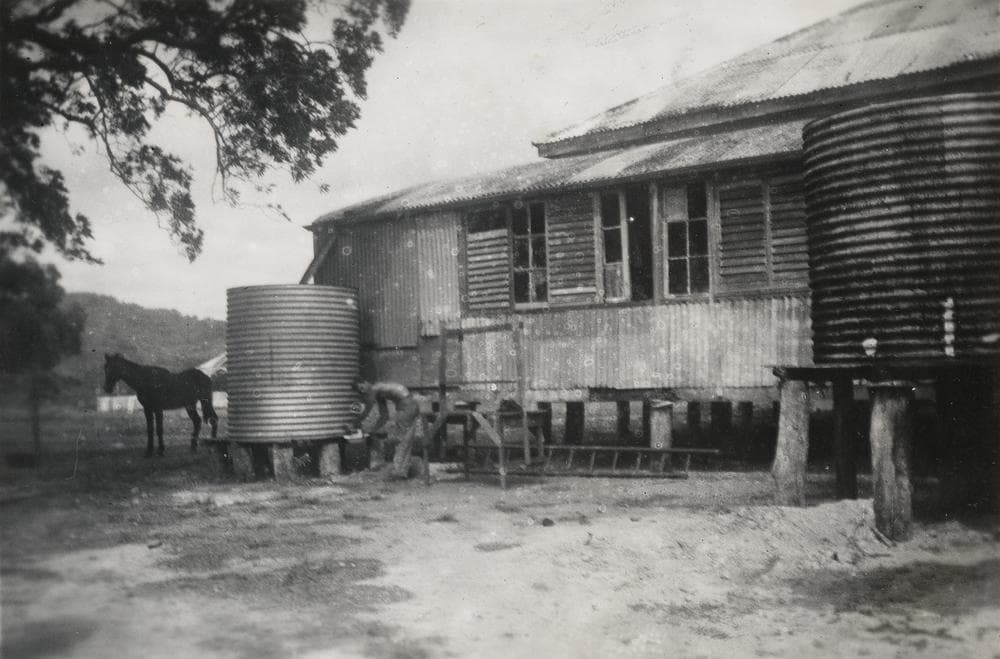
Photo: John Oxley Library, State Library of Queensland · Public domain · Source · Image credits

The 1942 Cooktown tanks on this page look quaint until you remember the two Queensland moods: too much water, then not enough. A custom home that treats plumbing as “the builder will connect it” will meet both moods unprepared. Tanks, gutters, overflows, on-site detention and a garden that can go brown without dying are design.
Council rules, plumbing codes and drinking-water advice change. Check the current scheme and a licensed plumber. This is the owner’s map.
Catchment is a roof plan
You cannot tank what you did not catch. A roof full of tiny hips, or a verandah that dumps onto paving, is a lost catchment. Simple roofs help cyclones and water. Cyclone, roofing.
First-flush, screens and a way to inspect the tank are not optional if anyone will drink or brush teeth from it. Many urban tanks are garden-and-toilet tanks, which is still worthwhile if you size to the irrigation you will actually turn off.
Put the tank where a truck can place it, where an overflow can go somewhere legal, and where it will not cook against a western wall like a radiator.
Stormwater is a neighbour story
Water that leaves your roof and slab has to leave without inventing a creek through the next lot. On clay, on a slope, or in a small-lot Brisbane suburb this is a drawing, not a hose. Sloping blocks, approvals.
Overland flow paths are not extra garden. Do not put a rumpus room in one. Flood.
Paving everything for the boat will make the storm your personal problem. Permeable areas and a place for a rain garden are custom-home finishes, not hippie extras.
Drought manners
A tropical garden that needs daily potable water is a hobby. Choose plants for the region — Cairns is not Toowoomba — and put drip where you mean it. Greywater has rules; do not invent a system from a video.
Pools evaporate. If you want one, own the water story. Pools.
Insurers and councils both care, in different years, about tanks and about runoff. Ask before you hide a tank behind a pretty wall that cannot be serviced.
A brief for the hydraulic meeting
Write: this is how we will use tank water, this is where overflow goes, this is the flood or detention constraint, and we will not pave the lot to death. Then keep tanks in the cost guide as a line, not as a hope.
Drinking, gardens and the two-pipe honesty
If any tap might be tank water, label it. Guests, trades and future buyers deserve not to guess. Backflow and cross-connection are plumbing law, not a vibe. Hire a licensed plumber who has done dual-supply houses, not a friend with a roll of poly.
Garden tanks should be sized to the beds you will keep in a dry September, not to the nursery invoice from opening weekend. A smaller tank that is used is better than a silo that goes brackish.
Detention, rain gardens and the urban lot
Many south-east lots now need on-site detention or quality treatment. These are design objects: a tank, a pit, a planted trench. They fail when they are squeezed behind a bin court nobody can access. Put them on the site plan with a maintenance note.
Do not plant a rain garden you will not weed. A blocked system is a flood on a small scale.
Queensland has always been a tank state when it remembers. The Cooktown photograph is not nostalgia. It is a specification.
Mosquitoes, lids and the tank as a living object
A tank that is not screened is a breeding site. Lids, meshes and a way to inspect without falling in are part of the product. In the wet tropics this is public health, not fussiness.
Overflows should land where they do not undermine a footing or a neighbour. Splash is a design problem.
In a drought, a tank that is empty is still useful as detention if the plumbing was thought through. In a flood, a tank that is empty can float. Design for both moods or pick a different object.
Firefighting fittings, flood straps and the tank that has two jobs
On rural and BAL lots a tank may be part of firefighting. On flood lots it must not float. Those jobs can conflict. Say which job is primary, then engineer the other as a constraint. A pretty tank that fails both is landscaping, not resilience.
Gutters, overflows and the afternoon cell
Tropical cells will find the low point. Give every gutter a second way out. Walk the overflows in a storm. If water is entering a door, the tank story is unfinished. Resilience is a wet afternoon, not a product photograph. Put a child-safe way to see the water level so someone actually uses the tank, because an ignored tank is only a mosquito hotel with a tap that nobody trusts when the restrictions finally arrive. Label every tap that might be tank water. Teach guests. A custom water system that needs a local to explain it is unfinished. Labels are architecture too, and they are cheaper than a weekend of stomach complaints or a plumber asked to undo a cross-connection that a clever owner invented with a hose. Give the overflow a legal, visible place to land and watch it in the first storm. If you cannot see it, you do not own a system — you own a rumour with a tap and a lid that will breed mosquitoes until someone remembers the tank exists. Size the tank to a use you will keep in September, then label the taps. An oversized silo that nobody trusts is not resilience. It is a monument to a brochure, complete with a tap that stays unused until the restrictions arrive.
Catchment is a roof plan, overflow is a neighbour story, and a tank is a living object with a lid, a label and a job. Size it to a September use. Strap it on a flood lot. Watch the first storm. Queensland will flood you and then refuse to rain. A custom house that treats plumbing as someone else’s hose is not ready for either mood.
Frequently asked questions
- Are tanks still worth it on town water?
- Often yes, for gardens, toilets and the political weather of restrictions — and because a tank is a buffer in a burst-main week. Size them to a use, not to a brochure.
- Can a tank make flood risk worse?
- An empty unrestrained tank can float and travel. A badly placed tank can block flow. Flood lots need tanks designed as flood objects. See the flood essay.
- Do I need a stormwater engineer for a house?
- On many urban and sloping lots, yes. Council will tell you when. Guessing with a PVC pipe to the neighbour is not a system.